
Book Recommendation: Your Guide to Safer Travel
This article contains affiliate links. As an Amazon Associate, I may earn a small commission from qualifying purchases at no extra cost to you. These commissions help support my work and allow me to continue creating thoughtful travel and lifestyle content. Thank you for your support.
Traveling is one of life’s great joys, but to be honest, it does come with risks.
Not necessarily dangers around every corner, but situations that require awareness, preparation, and good judgment. And in today’s world, many travelers are thinking more seriously about safety than ever before.
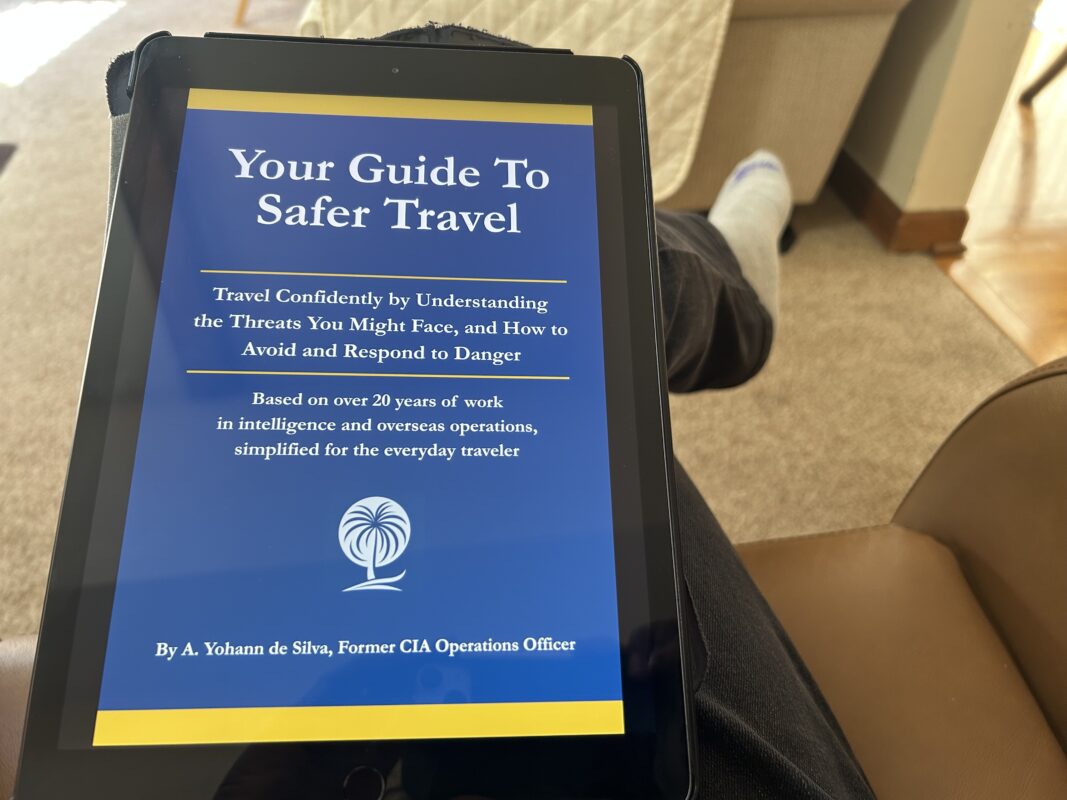
That’s why I recently read Your Guide to Safer Travel: Travel Confidently by Understanding the Threats You Might Face, and How to Avoid and Respond to Danger, written by A. Yohann de Silva.
This guide is based on the author’s more than 20 years of work in intelligence and overseas operations and is simplified for everyday travelers like you and me.
And by the way, this guide feels more serious in tone than many travel books I’ve read.
But in some ways, that’s exactly what makes it stand out.
About the Author
A. Yohann de Silva, is a former CIA operations officer with more than two decades of experience working both in the United States and internationally.
His background includes extensive training in personal security not only for himself, but also for colleagues and others working in overseas environments.
Right at the beginning of the book, there is a disclaimer stating that the opinions expressed are his own and do not represent official U.S. government views. I appreciated knowing that, given that the cover of the book looks quite official.
But considering his background, you can understand why.
What This Guide Covers
This is another short but information-packed guide. At 46 pages, it’s a quick but meaningful read.
The focus of this book is on personal security awareness, especially for travelers visiting low- to medium-risk destinations rather than active conflict zones.
Some of the topics discussed include:
- Hotel selection and room safety
- Transportation awareness
- Crowded places and tourist areas
- Airline travel considerations
- Luggage and identification risks
- Social media safety while traveling
- Recognizing vulnerabilities travelers may overlook
What stood out to me is how the author presents realistic scenarios, not to frighten travelers, but to help them recognize situations where they could unknowingly become vulnerable.
What I Liked About This Guide
The book is short, but it is packed with useful information.
And in today’s busy world, sometimes that’s exactly what we need: a quick read that delivers valuable insights without requiring hours and hours of time.
Another thing I appreciated is that the author highlights situations that many typical travelers, myself included, don’t always think about.
For example:
- How the type of hotel you choose could affect your safety
- Where your room is located within the hotel
- Risks associated with crowded places and tourist-heavy locations
- Even how clothing or logos displayed on clothing could draw attention in ways you may not expect
- That last one really made me think, especially the part about the logos.
The Insight That Confirmed My Instincts
This one really resonated with me: hotel selection.
Over the years, I’ve often chosen to stay in well-rated 3- or 4-star hotels that are commonly used by local travelers, rather than automatically selecting large international luxury hotels.
Reading this book confirmed something I had sensed but never fully articulated.
The author explains that in some destinations, high-profile international hotels, especially those frequented by expatriates, foreign officials, or large numbers of international visitors, can sometimes attract unwanted attention or become potential targets.
That doesn’t mean travelers should avoid these hotels altogether. But it does suggest that thoughtful hotel selection matters, and that sometimes blending in with local patterns can be a wise strategy.
For me, this reinforced my habit of choosing comfortable, reputable hotels used by locals, rather than assuming that the most expensive or internationally branded option is always the safest.
It was reassuring to see my instincts supported by someone with professional security experience.
My Personal Takeaway
One idea from this book that really stayed with me was the concept that predictability is not always an asset.
Sometimes, unpredictability can actually increase your safety.
The author explains that predictable routines, especially while traveling, can make travelers easier to observe or target. That insight made me rethink some of my own habits.
For example, I used to visit the same ATM locations out of convenience. After reading this guide, I became more intentional about varying the ATM locations I use rather than relying on the same one repeatedly.
I also enjoy walking around neighborhoods when I travel. It’s one of my favorite ways to explore and get a feel for a place. But now, I make a conscious effort to vary my walking routes and the times I go out, instead of following the same patterns day after day.
These are small changes, but they can make a meaningful difference.
It’s not about living in fear.
It’s about being aware and making thoughtful adjustments that help you travel more safely.
Who This Guide Is Best For
I would recommend this guide for:
- Travelers who want to better understand safety risks
- Solo travelers
- Group travelers
- Business travelers
- Leisure travelers
- Students studying abroad
- Anyone who wants to travel more confidently and thoughtfully
Even experienced travelers may discover vulnerabilities they had never considered before.
I certainly did.
My Final Thoughts
Travel does come with risks – from delays and illness to theft or unexpected situations. But that hasn’t stopped people from traveling, and it likely never will.
The key is not fear.
The key is awareness.
While the tone of this guide is more serious than many travel books, I did not find it alarming or fear-based. Instead, I found it informative and thought-provoking. It provides the kind of information that helps you travel with greater awareness, not anxiety.
And in uncertain times, that kind of preparation can make all the difference.